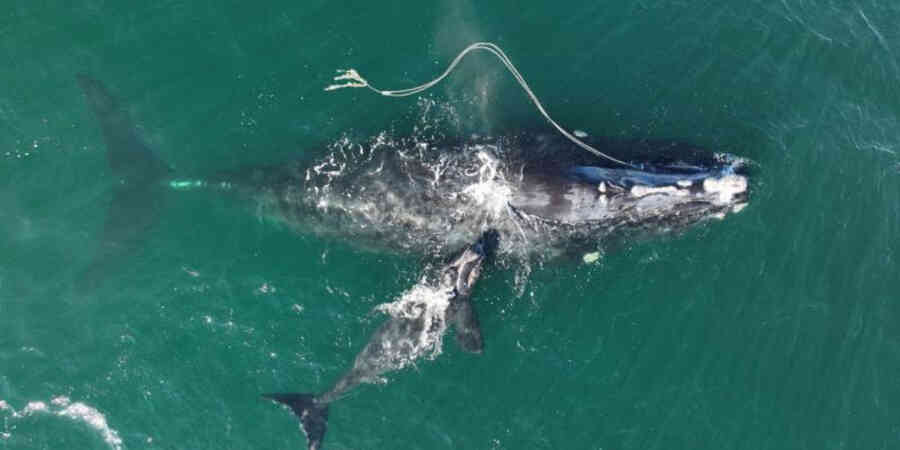
Stop Fishing Ropes From Killing Endangered Whales
More than 85% of North Atlantic right whales have been entangled in fishing gear at least once. Some survive with terrible injuries. Others struggle for months before dying.

And with only about 380 of these endangered whales remaining, every preventable death matters.

We have technology that could help save them. Now we need federal officials to put it to work.

Traditional fishing gear often relies on ropes stretching from the ocean floor to buoys at the surface. Whales swimming through these waters can become trapped, with ropes wrapping around their bodies, cutting into their skin, and making it difficult to swim, feed, or breathe.

Even whales that escape can suffer lasting injuries. Entanglement can also drain the energy female whales need to reproduce and raise their calves.

And the problem is far from under control. According to a new analysis by the Center for Biological Diversity, at least 31 whales were found entangled in fishing gear off the East Coast in the first nine months of 2026 alone. Over the past decade, at least 335 entanglements have been documented in the region, including 50 involving critically endangered North Atlantic right whales. And those are just the cases we know about. Many entanglements are never witnessed or reported.

And whales aren't the only victims. Endangered leatherback sea turtles and other marine animals face similar dangers.

But there's a promising solution: ropeless fishing gear.

Also called on-demand gear, this technology keeps vertical buoy lines out of the water until the equipment needs to be retrieved. That means fewer opportunities for whales and other animals to become entangled.

And it works. NOAA's experimental testing program has achieved a retrieval success rate exceeding 90%.

Yet despite years of promising research, ropeless technology has not been widely adopted in fisheries where dangerous entanglements continue.

NOAA Fisheries recently sought public input on expanding the voluntary use of ropeless gear. That should be a step toward meaningful action, not another round of discussion while endangered animals continue to suffer.

The agency should prioritize high-risk areas, remove unnecessary barriers to adoption, and establish a clear path toward broader use of this potentially lifesaving technology.

Endangered whales cannot afford to wait for another generation of research while preventable entanglements continue. Please sign the petition urging NOAA Fisheries to expand the use of ropeless fishing gear to protect endangered whales and other marine wildlife.

The petition to NOAA Fisheries reads: We urge NOAA Fisheries to accelerate the adoption of ropeless fishing gear in fisheries that threaten endangered whales and other marine wildlife. Prioritize high-risk areas, support the transition to proven technologies, and establish stronger protections that reduce dangerous vertical fishing lines. NOAA must turn promising research into meaningful action before more endangered animals are injured or killed.

_______

Source:

https://www.biologicaldiversity.org/w/news/press-releases/at-least-31-whales-entangled-off-east-coast-so-far-in-2026-2026-10-01/

Photo Credit: Georgia Department of Natural Resources/NOAA Permit #20556.
By signing, you’re agreeing to receive periodic messages from Animal Commons—you can unsubscribe anytime. For texts, message & data rates apply.
While on this site, you may also see content from other organizations that use CivicShout.com, the content of which Animal Commons is not responsible for.