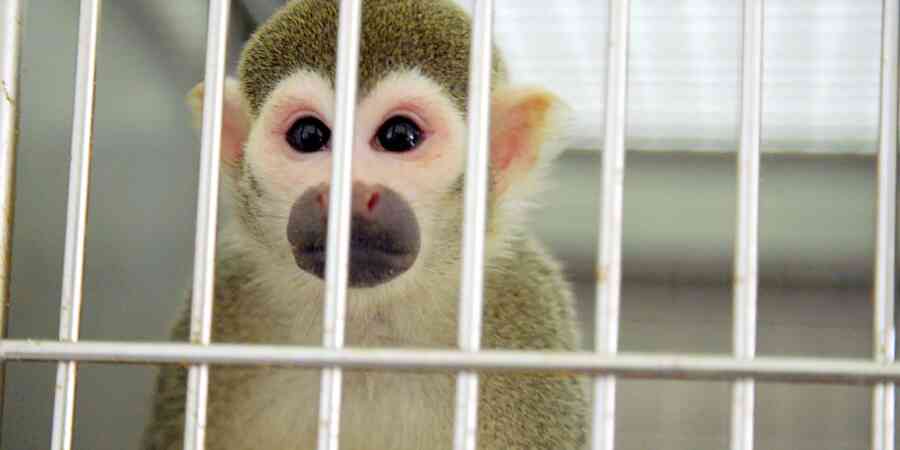
Tell Congress: Primates Belong in the Wild, Not Labs
A monkey should never be shipped across the world just to end up in a laboratory cage. But that is exactly the kind of cruelty America’s primate import pipeline makes possible — turning intelligent, social animals into cargo for a research system the federal government itself is beginning to move beyond.

Before a nonhuman primate reaches a lab, there is often a long and frightening journey: captured or bred for export, packed into crates, flown into the United States, held in quarantine, moved through dealers and facilities, and eventually shipped again toward research and testing.

That is the pipeline now coming into focus in Southwest Florida. According to records, thousands of monkeys were shipped out of the region last year — each one a living, feeling primate caught in a system that treats intelligent, social animals like cargo.

This is not just a Florida story. It is an American cruelty problem.

Primates are highly social animals with complex emotions, strong bonds, and the capacity to suffer fear, stress, grief, and pain. In laboratories, they can be confined for years, subjected to invasive procedures, separated from other animals, and denied the freedom, enrichment, and social lives they need to thrive.

The cruelty of this system has already had deadly consequences. One federal citation was issued after two monkeys died inside a room that reached 104 degrees, and inspectors later classified the incident as a critical violation of the Animal Welfare Act.

No primate belongs in that system. No animal should be shipped across the world just to be warehoused, experimented on, and treated as disposable research equipment.

The cruelty is even harder to justify at a time when U.S. federal agencies are moving toward more modern, human-centered science. The FDA has announced new steps to reduce animal testing in drug development, including changes involving monoclonal antibodies, cancer drugs, and other preclinical safety studies. The NIH has also launched new efforts to expand non-animal and human-based research methods while reducing animal use.

Congress should follow that momentum — not keep feeding the primate trade.

The bipartisan PRIMATE Act, introduced by Reps. Greg Steube and Dina Titus, would prohibit the importation of nonhuman primates into the United States, with supporters emphasizing the risk of introducing dangerous pathogens and strengthening U.S. biosecurity.

Those public health concerns matter. But the moral issue is just as urgent: America should not keep importing intelligent, social animals into a research system that causes profound suffering when humane alternatives are so readily available.

Please sign the petition to tell Congress: Pass the bipartisan PRIMATE Act and end this cruel, risky, and unnecessary trade in animals for research.

The petition to Congress reads: Pass the PRIMATE Act and ban the importation of nonhuman primates into the United States for laboratories. Primates are living, feeling beings — not cargo, not test tubes, and not disposable research supplies. Congress must protect animals, advance modern science, and reduce public health risks by ending this cruel import pipeline.

_______

Source:

https://www.winknews.com/wink_investigations/records-reveal-thousands-of-primates-shipped-out-of-swfl-last-year-lawmaker-seeks-ban-on/article_7af80bfc-5b21-4148-aa16-8c9b2b7bae05.html
By signing, you’re agreeing to receive periodic messages from Animal Commons—you can unsubscribe anytime. For texts, message & data rates apply.
While on this site, you may also see content from other organizations that use CivicShout.com, the content of which Animal Commons is not responsible for.