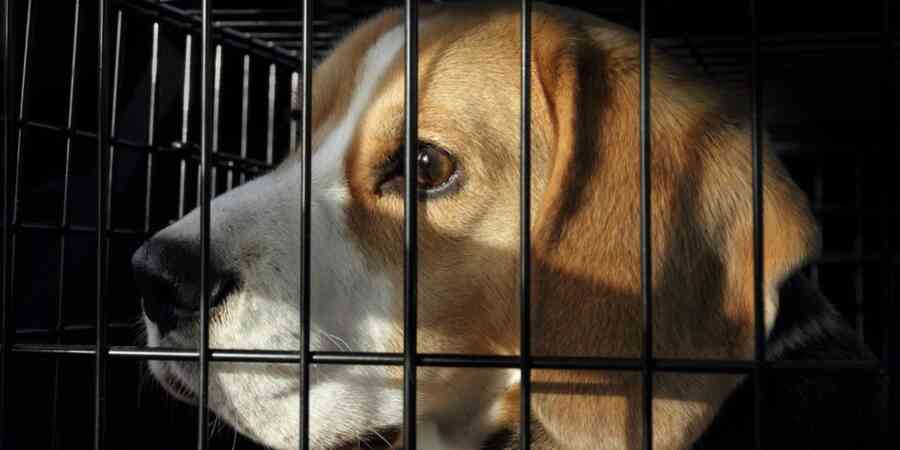
Tell Congress: End Taxpayer-Funded Dog and Cat Experiments
Dogs and cats should not disappear behind laboratory doors simply because federal money is paying the bill.

Yet dogs and cats are still used in biomedical research in the United States — even as scientists develop increasingly sophisticated ways to study human biology without relying on live animals.

Congress must pass new, bipartisan legislation to help change that.

The Companion Animal Protection Against Cruel Testing Act, or COMPACT Act (H.R. 10522), is a bipartisan bill that would prohibit the Department of Health and Human Services from using federal funds for biomedical research involving live dogs and cats, while allowing research intended to benefit the health and well-being of dogs and cats themselves.

That matters because HHS oversees some of the nation's largest health and research agencies, including the National Institutes of Health and the Food and Drug Administration.

For animals caught in the research system, the consequences can be profound. Dogs and cats may be bred specifically for laboratory use, confined for extended periods and subjected to experimental procedures before their fate is decided.

At the same time, biomedical science is advancing. Researchers increasingly have access to methods built around human biology itself, including human cells and tissues, organoids, organ-on-chip technology and sophisticated computer models.

These approaches are already expanding the range of research that can be conducted without putting live dogs and cats through experiments. In recent years, federal agencies have also expanded support for these "new approach methodologies" as part of a broader effort to reduce reliance on animal testing.

The COMPACT Act would establish a clear federal funding boundary around dogs and cats, strengthen accountability for federal research spending, and preserve research specifically intended to benefit dogs and cats themselves.

Introduced by Rep. Nicholas Langworthy (R-N.Y.) and Rep. Mark Pocan (D-Wis.), the bipartisan legislation has been referred to the House Energy and Commerce Committee.

Congress should seize this opportunity to encourage modern, human-relevant research while ending taxpayer funding for biomedical research involving live dogs and cats.

Please sign this petition urging Congress to pass the bipartisan COMPACT Act (H.R. 10522) and help accelerate the transition to modern, human-relevant research methods while preserving research intended to benefit dogs and cats themselves.

The petition to Congress reads: Please pass the bipartisan Companion Animal Protection Against Cruel Testing (COMPACT) Act (H.R. 10522). As scientists develop more sophisticated human-based research methods, taxpayer dollars should no longer fund biomedical research involving live dogs and cats. Support modern, human-relevant science by passing the COMPACT Act and helping accelerate the transition to research methods that reduce reliance on companion animals while preserving research intended to benefit dogs and cats themselves.
_______

Source:

https://animalwellnessaction.org/wp-content/uploads/2026/09/COMPACT-Act-Fact-Sheet-092226.pdf
By signing, you’re agreeing to receive periodic messages from Animal Commons—you can unsubscribe anytime. For texts, message & data rates apply.
While on this site, you may also see content from other organizations that use CivicShout.com, the content of which Animal Commons is not responsible for.